

34 Days of Video Lessons
Each day we look at something new. Starting with just notes, then octave patterns, bar chords and all of the major and minor triads.

Daily Interactive Exercises
Using small daily exercises we slowly and steadily build up muscle memory that will give you immediate access to the entire fretboard.

272 Unique Flashcards
Utilizing a free advanced flashcard application called ANKI you have access to our deck of 272 unique flashcards that will imbed the anatomy of the fretboard deep into your long term memory.

THE PRINCIPLES THAT MAKES THIS COURSE WORK:

#1 - Spaced Repetition
In order to transfer skills into long-term memory, we need to repeat them many times—but not all at once
Weirdly enough, forgetting something a little bit before reviewing it actually makes the memory stronger.
That’s why this course spreads the learning out. Instead of cramming everything into a couple of days, we revisit the information over weeks. The daily flashcard exercises are timed perfectly to make sure your brain has just the right amount of challenge to grow.
We use an advanced flashcard application called Anki which spaces out your practice based on how well you’re doing. Each day, you’ll tackle new cards while older ones fade into the background as they become permanent fixtures in your memory.
But it’s not just flashcards. We also use spaced repetition in a bigger way, revisiting each string of the fretboard multiple times throughout the course. With each revisit, you’ll connect what you’ve already learned to new concepts, like octave patterns or chord shapes. This layering approach helps you build a massive, interconnected map of the fretboard in your mind.
#2 - Contextual Learning:
Building a Web of Knowledge
Learning isn’t just about memorizing facts—it’s about connecting them in meaningful ways.
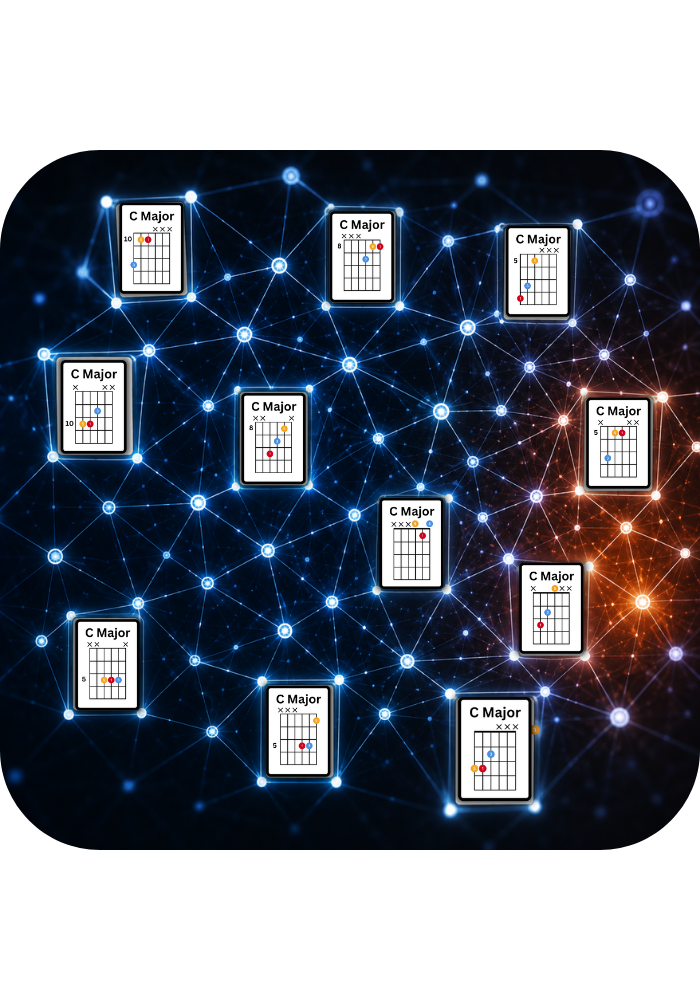
By linking one piece of information to another, your brain creates a web of connections that makes everything easier to remember and faster to recall.
During this course you will connect each note on the fretboard to
- Chord shapes
- Octave patterns
- Major and Minor Triads
Each connection reinforces the memory and gives your brain multiple ways to retrieve it.
These connections create a framework that doesn’t just help you remember—it helps you understand the fretboard as a whole.

#3 - Retrieval Practice: Training Your Brain’s Access Points
Having a piece of knowledge in your head is not the same as being able to access it when you need it.
Retrieval practice is all about training your brain to access the memories you’ve stored as quickly and effectively as possible.
When accessing the fretboard we need two seperate retrieval pathways:
- From note to name (e.g., “What’s the name of this note?”)
- From name to note (e.g., “Where is D on the low E string?”)
Using two different exercises this course trains both pathways every day. The flashcard exercises handle the first pathway, challenging you to name notes, chords, and triads from visual cues. The second pathway gets a workout with the random chord generator, which prompts you to find notes or chords on your instrument in time with a metronome.
Both exercises are simple, but they’re powerful. Together, they’ll make retrieving information from your memory second nature—so when it’s time to play, your knowledge is at your fingertips (literally).
#4 - Chunking: Turning Small Pieces Into Big Ideas
Your brain has a clever way of dealing with its limited working memory: it combines small pieces of information into larger, more manageable chunks.
This is how we remember 10 digit phone numbers. By splitting them into three manageable chunks that can be recalled as a unit. It's like compressing files on a computer—it lets you store and recall much more information with less effort.
Here’s how chunking works:
- At first, your brain sees each piece of information as separate. For example, the notes on the low E string—E, F, G, A, B, C, D—might feel like seven individual pieces.
- But through repetition and practice, your brain starts grouping them together into one “chunk.” Now, instead of thinking of them as seven separate notes, you recall them as one unified set.
This frees up mental space in your working memory to focus on something else—like adding octave patterns, triads, or chord shapes to the mix. Over time, these new chunks combine into even larger structures, creating a scaffold of knowledge that you can rely on without overloading your brain.

This Course Will Allow You to:
✅ Master the notes on the fretboard with deep, intuitive knowledge
✅ Finally understand the fretboard in a way that feels natural, practical, and usable.
✅ Free yourself from the confusion that keeps so many guitarists stuck
✅ Make every other part of your guitar learning journey smoother, faster, and easier
✅ Learn to instantly apply chords, scales, triads, and musical concepts anywhere on the neck
✅ Build the kind of fretboard fluency that makes playing more effortless.
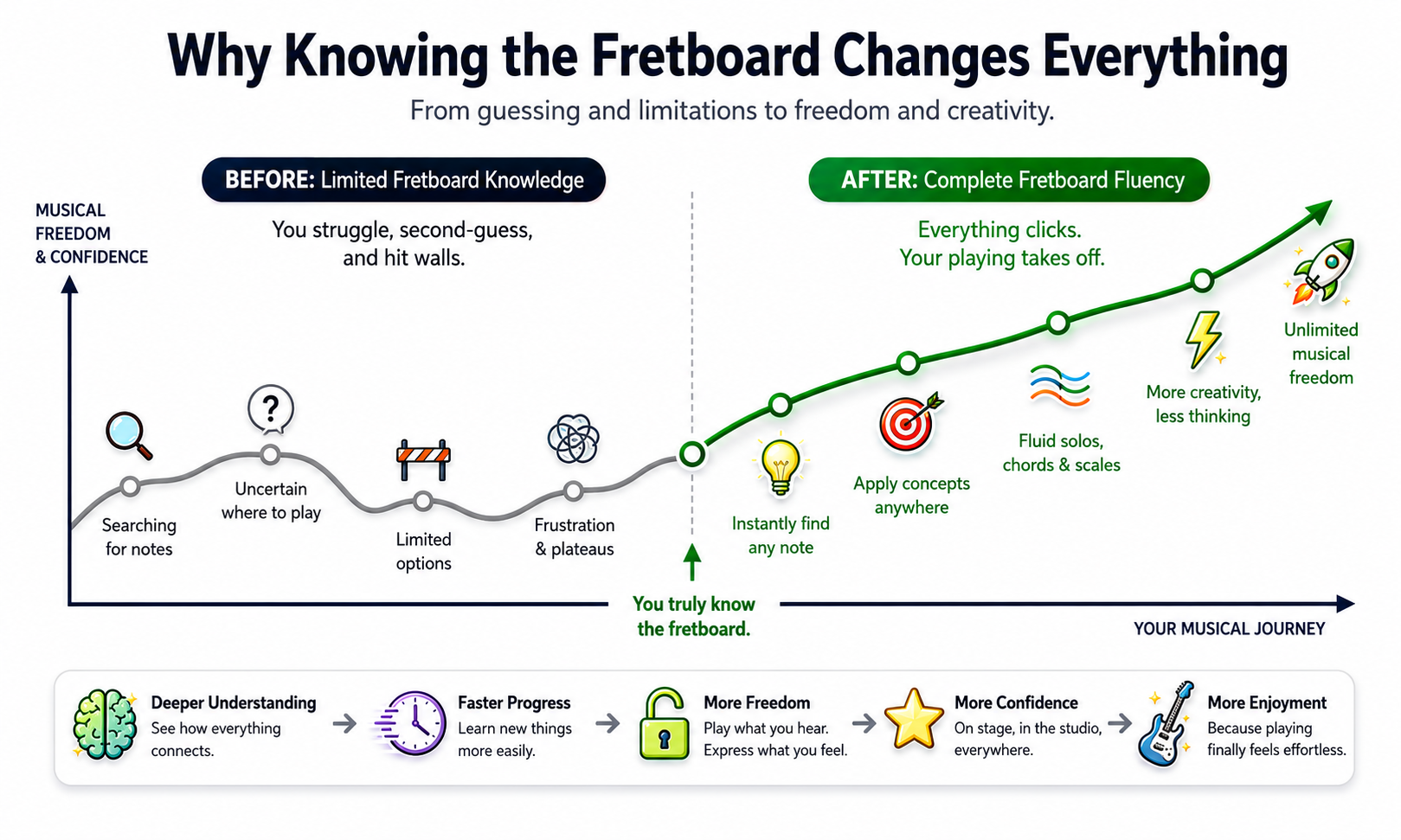
✅ Experience the freedom of finally knowing your instrument the way a piano player knows the keys.